Содержимое курса
Additional and Extra materials
Here you can find different useful links, books and worksheets
0/6
General physics

Beta Decay and Quark Composition — Physics Lesson

? Learning Objectives

Learning Objectives

  • Describe the changes to quark composition that take place during β⁻ and β⁺ decay
  • Recall that electrons and neutrinos are fundamental particles called leptons
  • Understand the role of the weak nuclear force in beta decay processes
  • Apply conservation laws to beta decay reactions at the quark level
  • Distinguish between different types of fundamental particles
  • Analyze beta decay processes using quark models
?️ Language Objectives

Language Objectives

  • Use scientific terminology related to particle physics and nuclear decay accurately
  • Explain quark transformations using precise particle physics language
  • Describe fundamental particle classifications clearly
  • Communicate decay processes using appropriate scientific discourse
  • Distinguish between technical terms (quarks, leptons, hadrons) effectively
? Key Terms

Key Terms

English TermRussian TranslationKazakh Translation
Beta Decay (β⁻)Бета-минус распадБета-минус ыдырау
Beta Plus Decay (β⁺)Бета-плюс распадБета-плюс ыдырау
QuarkКваркКварк
Up Quarku-кварк (верхний)Жоғарғы кварк (u)
Down Quarkd-кварк (нижний)Төменгі кварк (d)
LeptonЛептонЛептон
ElectronЭлектронЭлектрон
NeutrinoНейтриноНейтрино
AntineutrinoАнтинейтриноАнтинейтрино
PositronПозитронПозитрон
Weak Nuclear ForceСлабое ядерное взаимодействиеӘлсіз ядролық күш
Fundamental ParticleФундаментальная частицаІргелі бөлшек
? Topic Flashcards

Interactive Flashcards

Practice with these flashcards to memorize key concepts about beta decay and fundamental particles.

? Glossary

Glossary

Beta Minus Decay (β⁻)
A type of radioactive decay in which a neutron in the nucleus converts to a proton, emitting an electron and an antineutrino. At the quark level, a down quark transforms into an up quark.
Translation
Russian: Бета-минус распад — тип радиоактивного распада, при котором нейтрон в ядре превращается в протон, испуская электрон и антинейтрино. На уровне кварков нижний кварк превращается в верхний кварк.
Kazakh: Бета-минус ыдырау — ядродағы нейтронның протонға айналып, электрон мен антинейтрино бөліп шығаратын радиоактивті ыдырау түрі. Кварк деңгейінде төменгі кварк жоғарғы кваркке айналады.
Beta Plus Decay (β⁺)
A type of radioactive decay in which a proton in the nucleus converts to a neutron, emitting a positron and a neutrino. At the quark level, an up quark transforms into a down quark.
Translation
Russian: Бета-плюс распад — тип радиоактивного распада, при котором протон в ядре превращается в нейтрон, испуская позитрон и нейтрино. На уровне кварков верхний кварк превращается в нижний кварк.
Kazakh: Бета-плюс ыдырау — ядродағы протонның нейтронға айналып, позитрон мен нейтрино бөліп шығаратын радиоактивті ыдырау түрі. Кварк деңгейінде жоғарғы кварк төменгі кваркке айналады.
Quark
Fundamental particles that combine to form hadrons (such as protons and neutrons). There are six types of quarks: up, down, charm, strange, top, and bottom.
Translation
Russian: Кварки — фундаментальные частицы, которые объединяются для образования адронов (таких как протоны и нейтроны). Существует шесть типов кварков: верхний, нижний, очарованный, странный, истинный и прелестный.
Kazakh: Кварктер — адрондарды (протондар мен нейтрондар сияқты) құрайтын іргелі бөлшектер. Алты түрлі кварк бар: жоғарғы, төменгі, сүйкімді, таңғажайып, шынайы және әдемі.
Up Quark (u)
A fundamental particle with electric charge +2/3 and found in protons and neutrons. Protons contain two up quarks and one down quark (uud).
Translation
Russian: Верхний кварк (u) — фундаментальная частица с электрическим зарядом +2/3, входящая в состав протонов и нейтронов. Протоны содержат два верхних кварка и один нижний кварк (uud).
Kazakh: Жоғарғы кварк (u) — +2/3 электр зарядына ие және протондар мен нейтрондардың құрамына кіретін іргелі бөлшек. Протондарда екі жоғарғы кварк пен бір төменгі кварк бар (uud).
Down Quark (d)
A fundamental particle with electric charge -1/3 and found in protons and neutrons. Neutrons contain one up quark and two down quarks (udd).
Translation
Russian: Нижний кварк (d) — фундаментальная частица с электрическим зарядом -1/3, входящая в состав протонов и нейтронов. Нейтроны содержат один верхний кварк и два нижних кварка (udd).
Kazakh: Төменгі кварк (d) — -1/3 электр зарядына ие және протондар мен нейтрондардың құрамына кіретін іргелі бөлшек. Нейтрондарда бір жоғарғы кварк пен екі төменгі кварк бар (udd).
Lepton
A family of fundamental particles that do not participate in the strong nuclear force. Includes electrons, muons, taus, and their associated neutrinos.
Translation
Russian: Лептоны — семейство фундаментальных частиц, которые не участвуют в сильном ядерном взаимодействии. Включает электроны, мюоны, тау-частицы и связанные с ними нейтрино.
Kazakh: Лептондар — күшті ядролық күшке қатыспайтын іргелі бөлшектердің тобы. Электрондар, мюондар, тау-бөлшектер және олармен байланысты нейтриноларды қамтиды.
Neutrino
A nearly massless, electrically neutral fundamental particle that rarely interacts with matter. Produced in nuclear reactions including beta decay.
Translation
Russian: Нейтрино — практически безмассовая, электрически нейтральная фундаментальная частица, которая редко взаимодействует с веществом. Образуется в ядерных реакциях, включая бета-распад.
Kazakh: Нейтрино — массасы жоқтың қасында, электр бейтарап іргелі бөлшек, заттармен сирек әрекеттеседі. Бета-ыдырауды қоса алғанда, ядролық реакцияларда пайда болады.
Weak Nuclear Force
One of the four fundamental forces of nature, responsible for certain types of radioactive decay including beta decay. It can change one type of quark into another.
Translation
Russian: Слабое ядерное взаимодействие — одна из четырех фундаментальных сил природы, ответственная за определенные виды радиоактивного распада, включая бета-распад. Может превращать один тип кварка в другой.
Kazakh: Әлсіз ядролық күш — табиғаттың төрт іргелі күшінің бірі, бета-ыдырауды қоса алғанда, радиоактивті ыдыраудың белгілі түрлеріне жауапты. Бір кварк түрін екіншісіне айналдыра алады.
? Theory: Beta Decay and Quark Transformations

Theory: Beta Decay and Fundamental Particles

Introduction to Beta Decay

Beta decay is a type of radioactive decay that occurs when a nucleus has an unstable ratio of protons to neutrons. Unlike alpha decay, beta decay involves the transformation of one type of nucleon into another.

Kazakh Translation
Бета ыдырау — ядрода протондар мен нейтрондардың тұрақсыз қатынасы болған кезде пайда болатын радиоактивті ыдыраудың бір түрі. Альфа ыдыраудан айырмашылығы, бета ыдырау нуклондардың бір түрінің екіншісіне түрлендірілуін қамтиды.
Beta minus decay

Beta minus decay showing neutron converting to proton

Types of Beta Decay

Beta Minus Decay (β⁻)

In beta minus decay, a neutron in the nucleus converts into a proton, emitting an electron (β⁻ particle) and an antineutrino.

Kazakh Translation
Бета-минус ыдырауда ядродағы нейтрон протонға айналып, электрон (β⁻ бөлшегі) мен антинейтрино бөліп шығарады.

Nuclear equation:

n → p + e⁻ + ν̄e

Beta Plus Decay (β⁺)

In beta plus decay, a proton in the nucleus converts into a neutron, emitting a positron (β⁺ particle) and a neutrino.

Kazakh Translation
Бета-плюс ыдырауда ядродағы протон нейтронға айналып, позитрон (β⁺ бөлшегі) мен нейтрино бөліп шығарады.

Nuclear equation:

p → n + e⁺ + νe

Beta plus decay

Beta plus decay showing proton converting to neutron

Quark Composition Changes

Understanding Quarks

Quarks are fundamental particles that make up protons and neutrons:

  • Proton (p): uud (two up quarks, one down quark)
  • Neutron (n): udd (one up quark, two down quarks)
Proton quark structure
Neutron quark structure

Quark composition of proton (left) and neutron (right)

Quark Properties

Quark TypeSymbolElectric ChargeFound In
Up quarku+2/3Protons and neutrons
Down quarkd-1/3Protons and neutrons

Quark Transformations in Beta Decay

β⁻ Decay at Quark Level:

A down quark in a neutron transforms into an up quark:

d → u + e⁻ + ν̄e
Neutron (udd) → Proton (uud) + electron + antineutrino

Kazakh Translation
β⁻ ыдырауда нейтрондағы төменгі кварк жоғарғы кваркке айналады. Нейтрон (udd) протонға (uud) айналып, электрон мен антинейтрино бөледі.

β⁺ Decay at Quark Level:

An up quark in a proton transforms into a down quark:

u → d + e⁺ + νe
Proton (uud) → Neutron (udd) + positron + neutrino

Kazakh Translation
β⁺ ыдырауда протондағы жоғарғы кварк төменгі кваркке айналады. Протон (uud) нейтронға (udd) айналып, позитрон мен нейтрино бөледі.
Beta decay at quark level

Quark-level view of beta minus and beta plus decay

Leptons: Fundamental Particles

Leptons are a family of fundamental particles that do not experience the strong nuclear force. The electron and neutrino produced in beta decay are both leptons.

Kazakh Translation
Лептондар — күшті ядролық күшті сезінбейтін іргелі бөлшектердің тобы. Бета ыдырауда пайда болатын электрон мен нейтрино екеуі де лептондар.

Types of Leptons

Charged LeptonsNeutral LeptonsGeneration
Electron (e⁻)Electron neutrino (νe)First
Muon (μ⁻)Muon neutrino (νμ)Second
Tau (τ⁻)Tau neutrino (ντ)Third

The Weak Nuclear Force

Beta decay is mediated by the weak nuclear force, one of the four fundamental forces. This force is unique because it can change the flavor (type) of quarks.

Kazakh Translation
Бета ыдырау төрт іргелі күштің бірі болып табылатын әлсіз ядролық күш арқылы жүзеге асады. Бұл күш ерекше, өйткені ол кварктардың дәмін (түрін) өзгерте алады.

Practice Questions

Question 1 (Easy):

What particles are emitted during β⁻ decay?

Answer
During β⁻ decay, an electron (e⁻) and an antineutrino (ν̄e) are emitted.

Question 2 (Medium):

Describe the quark composition change when a neutron undergoes β⁻ decay to become a proton.

Answer
Initial neutron: udd (one up quark, two down quarks)
Final proton: uud (two up quarks, one down quark)
Change: One down quark transforms into an up quark (d → u)
This transformation is mediated by the weak nuclear force and produces an electron and antineutrino.

Question 3 (Medium):

Explain why electrons and neutrinos are classified as leptons and what this means for their interactions.

Answer
Electrons and neutrinos are classified as leptons because they are fundamental particles that do not experience the strong nuclear force. This means they:
• Do not participate in holding nuclei together
• Can pass through matter more easily (especially neutrinos)
• Only interact via electromagnetic force (electrons) and weak nuclear force
• Are not made of quarks (unlike protons and neutrons)

Question 4 (Critical Thinking):

A student claims that during β⁺ decay, «a proton becomes a neutron by losing positive charge.» Evaluate this statement and provide a more accurate description using quark theory. Discuss why the weak nuclear force is essential for this process.

Answer
Evaluation of student’s statement:
The statement is partially correct but oversimplified. While the net effect is that a proton becomes a neutron, the mechanism is more complex.

More accurate description using quark theory:
• Initial proton has quark composition uud
• One up quark (charge +2/3) transforms into a down quark (charge -1/3)
• This changes the overall composition to udd (neutron)
• The change in charge is carried away by the emitted positron (+1) and neutrino (0)

Role of weak nuclear force:
• The weak force is the only fundamental force that can change quark flavor
• It mediates the u → d transformation through W+ boson exchange
• Without the weak force, quarks would be stable and nuclear transmutation impossible
• This force allows nature to achieve more stable nuclear configurations by changing proton/neutron ratios

? Memorization Exercises

Exercises on Memorizing Terms

Exercise 1: Fill in the Blanks

  1. In β⁻ decay, a _______ quark changes to an _______ quark.
  2. Electrons and neutrinos belong to a family of particles called _______.
  3. A proton has quark composition _______, while a neutron has composition _______.
  4. β⁺ decay emits a _______ and a _______.
  5. The _______ nuclear force is responsible for beta decay processes.

Answer
1. down, up
2. leptons
3. uud, udd
4. positron, neutrino
5. weak

Exercise 2: Quark Transformation Matching

Match each decay type with its quark transformation:

Decay Types:

  1. β⁻ decay
  2. β⁺ decay

Quark Transformations:

  • u → d + e⁺ + νe
  • d → u + e⁻ + ν̄e

Answer
1-B: β⁻ decay → d → u + e⁻ + ν̄e
2-A: β⁺ decay → u → d + e⁺ + νe

Exercise 3: Lepton Identification

Identify which of the following are leptons:

  1. Electron
  2. Proton
  3. Neutrino
  4. Up quark
  5. Muon
  6. Neutron
  7. Positron

Answer
Leptons: 1 (Electron), 3 (Neutrino), 5 (Muon), 7 (Positron)
Not leptons: 2 (Proton — made of quarks), 4 (Up quark — fundamental but not a lepton), 6 (Neutron — made of quarks)
? Educational Video
? Problem Solving Examples

Worked Examples

Example 1: β⁻ Decay Analysis
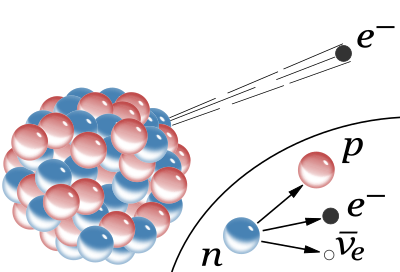
Beta minus decay diagram

Problem: Carbon-14 undergoes β⁻ decay to form nitrogen-14. Analyze this process at both the nuclear and quark levels.

? Audio Solution

Detailed Solution with Pronunciation

Nuclear Level Analysis: (pronounced: NEW-klee-ar LEV-el)

Nuclear equation: ¹⁴C → ¹⁴N + e⁻ + ν̄e

Carbon-14 (6 protons, 8 neutrons) becomes nitrogen-14 (7 protons, 7 neutrons)

One neutron converts to one proton

Quark Level Analysis: (pronounced: kwark LEV-el)

Initial neutron composition: udd

Final proton composition: uud

Transformation: d → u + e⁻ + ν̄e

One down quark changes to an up quark, producing electron and antineutrino

Conservation Check:

Charge: 6 = 7 + (-1) + 0 ✓

Nucleon number: 14 = 14 + 0 + 0 ✓

? Quick Solution

Brief Solution

Nuclear: ¹⁴C → ¹⁴N + e⁻ + ν̄e

Process: n → p conversion

Quark level:

Neutron (udd) → Proton (uud)

d → u + e⁻ + ν̄e

Result: C-14 becomes N-14

Atomic number increases by 1

Mass number stays same

Example 2: β⁺ Decay Analysis

Beta plus decay diagram

Problem: Fluorine-18 undergoes β⁺ decay to form oxygen-18. Describe the quark transformations and identify all products.

? Audio Solution

Detailed Solution with Pronunciation

Nuclear Equation: (pronounced: NEW-klee-ar ee-KWAY-zhun)

¹⁸F → ¹⁸O + e⁺ + νe

Fluorine-18 (9 protons, 9 neutrons) becomes oxygen-18 (8 protons, 10 neutrons)

Quark Analysis: (pronounced: kwark an-AL-i-sis)

Initial proton: uud composition

Final neutron: udd composition

Transformation: u → d + e⁺ + νe

One up quark changes to down quark

Products Identified:

Positron (e⁺): antiparticle of electron, lepton

Neutrino (νe): electrically neutral lepton

Both are fundamental particles

? Quick Solution

Brief Solution

Nuclear: ¹⁸F → ¹⁸O + e⁺ + νe

Process: p → n conversion

Quark transformation:

Proton (uud) → Neutron (udd)

u → d + e⁺ + νe

Products:

• Oxygen-18 nucleus

• Positron (lepton)

• Electron neutrino (lepton)

? Investigation Task

Interactive Simulation

Use this PhET simulation to explore radioactive decay and nuclear processes:

Investigation Questions:

  1. Observe carbon-14 decay. What type of decay occurs and what are the products?
  2. How does the ratio of protons to neutrons change during beta decay?
  3. What happens to the atomic number during β⁻ and β⁺ decay?
  4. Why do some nuclei undergo beta decay while others are stable?
Brief Answers
1. Carbon-14 undergoes β⁻ decay producing nitrogen-14, electron, and antineutrino
2. β⁻ decreases neutron/proton ratio; β⁺ increases neutron/proton ratio
3. β⁻ increases atomic number by 1; β⁺ decreases atomic number by 1
4. Nuclei with unstable neutron/proton ratios undergo beta decay to reach stability
? Group/Pair Activity

Collaborative Learning Activity

Work with your partner or group to complete this particle physics challenge:

Discussion Points:

  • How do quarks combine to form different particles?
  • What makes leptons different from quarks?
  • Why is the weak nuclear force called «weak» compared to other forces?
  • How do scientists detect neutrinos if they barely interact with matter?

Group Challenge Activities:

  • Create a «particle family tree» showing relationships between quarks and leptons
  • Design decay diagrams for different beta decay processes
  • Research applications of beta decay in medicine and dating techniques
  • Build models showing quark transformations during beta decay
✏️ Individual Assessment

Structured Questions — Individual Work

Question 1 (Analysis):

Potassium-40 can undergo both β⁻ decay (to calcium-40) and β⁺ decay (to argon-40).

  1. Write the nuclear equations for both decay processes.
  2. Describe the quark transformations in each case.
  3. Explain why the same nucleus can undergo different types of decay.
  4. Compare the products of each decay in terms of particle classification.
  5. Calculate the change in atomic number for each process.

Answer
a) β⁻: ⁴⁰K → ⁴⁰Ca + e⁻ + ν̄e; β⁺: ⁴⁰K → ⁴⁰Ar + e⁺ + νe
b) β⁻: d → u (neutron becomes proton); β⁺: u → d (proton becomes neutron)
c) K-40 is at borderline stability; both decay modes lead to more stable configurations
d) Both produce leptons (e⁻/e⁺ and neutrinos) but different types of neutrinos
e) β⁻: Z increases by 1 (19→20); β⁺: Z decreases by 1 (19→18)

Question 2 (Synthesis):

Design an experiment to distinguish between β⁻ and β⁺ decay using the properties of the emitted particles.

  1. Describe how you would detect the different types of beta particles.
  2. Explain how magnetic fields could be used to identify the particles.
  3. Discuss the challenges of detecting neutrinos in each process.
  4. Propose methods to confirm the nuclear transmutation has occurred.
  5. Evaluate the safety considerations for each type of decay.

Answer
a) Use charged particle detectors; β⁻ produces electrons, β⁺ produces positrons
b) Magnetic field deflects particles in opposite directions based on charge (e⁻ vs e⁺)
c) Neutrinos rarely interact; need large detectors and many decay events; antineutrinos vs neutrinos have different interaction cross-sections
d) Mass spectrometry to identify daughter nuclei; chemical analysis for element identification
e) β⁻ requires radiation shielding; β⁺ produces annihilation radiation (511 keV gamma rays) requiring additional precautions

Question 3 (Evaluation):

Compare and contrast beta decay with alpha decay in terms of fundamental particle involvement and nuclear changes.

  1. Identify which fundamental forces are involved in each process.
  2. Analyze the role of quarks in each type of decay.
  3. Compare the stability requirements for each decay mode.
  4. Evaluate the energy considerations for each process.
  5. Discuss applications of each decay type in nuclear medicine.

Answer
a) Beta: weak nuclear force; Alpha: strong nuclear force (overcomes electromagnetic repulsion)
b) Beta: quark flavor change (u↔d); Alpha: no individual quark changes, whole alpha particle emission
c) Beta: neutron/proton ratio instability; Alpha: heavy nuclei with excess nucleons
d) Beta: lower energy release; Alpha: higher energy release due to large mass difference
e) Beta: therapeutic radioisotopes, PET imaging; Alpha: targeted cancer therapy due to high local energy deposition

Question 4 (Critical Thinking):

The Standard Model predicts that neutrinos should be massless, but recent experiments suggest they have very small masses.

  1. Explain how neutrino oscillations provide evidence for neutrino mass.
  2. Discuss the implications of massive neutrinos for beta decay energy calculations.
  3. Analyze how this affects our understanding of lepton conservation laws.
  4. Evaluate the impact on cosmological models if neutrinos have mass.
  5. Propose experiments that could further investigate neutrino properties.

Answer
a) Neutrino oscillations (flavor changes) require mass differences between neutrino types; massless particles cannot oscillate
b) Small neutrino mass slightly affects energy balance in beta decay; most energy still goes to other products
c) Lepton number still conserved, but individual lepton flavors can change via oscillations
d) Massive neutrinos contribute to dark matter; affect big bang nucleosynthesis; influence large-scale structure formation
e) Long-baseline neutrino experiments; precision measurements of beta decay spectra; underground detectors to reduce background

Question 5 (Application):

Technetium-99m is widely used in medical imaging and decays by a process that doesn’t change its atomic number.

  1. Identify what type of decay this represents and explain why the atomic number doesn’t change.
  2. Compare this process to beta decay in terms of quark involvement.
  3. Explain why this isotope is particularly suitable for medical imaging.
  4. Analyze the advantages and disadvantages compared to β⁻ or β⁺ emitters.
  5. Discuss how the decay products differ from those in beta decay.

Answer
a) Gamma decay (isomeric transition); nuclear energy state changes without changing proton/neutron numbers
b) No quark flavor changes occur; nucleus transitions from excited to ground state
c) 6-hour half-life ideal for imaging; pure gamma emission; no charged particle radiation to harm patients
d) Advantages: no ionizing particles, precise imaging; Disadvantages: requires shielding, more expensive production
e) Only electromagnetic radiation (gamma rays) produced; no leptons or charged particles like in beta decay
? Additional Resources

Useful Links and References

? Study Materials:

? Video Resources: