SlidesVideoInteractive lessonWorksheet 1Worksheet 2
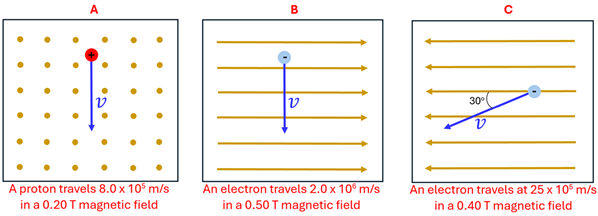
1. Determine the magnitude and direction of the magnetic force acting on the given charge in each of these situations.
 Solar activity can send protons toward the Earth with a large velocity. When such a proton enters the Earth’s magnetic field at an angle less than 90o, a component of the Earth’s field will be perpendicular to the velocity while another component will be parallel to the proton’s velocity. The result is that the proton travels in a helical spiral as shown. Assume a proton is traveling at 240 km/s when it enters the Earth’s 25 µT magnetic field at an angle of 75 with respect to the field.
(a) What magnetic force acts on the proton, and (b) why would this trajectory trace out a helix instead of just a circle?
Solar activity can send protons toward the Earth with a large velocity. When such a proton enters the Earth’s magnetic field at an angle less than 90o, a component of the Earth’s field will be perpendicular to the velocity while another component will be parallel to the proton’s velocity. The result is that the proton travels in a helical spiral as shown. Assume a proton is traveling at 240 km/s when it enters the Earth’s 25 µT magnetic field at an angle of 75 with respect to the field.(a) What magnetic force acts on the proton, and (b) why would this trajectory trace out a helix instead of just a circle?
Source: https://www.physicsclassroom.com/class/Magnetic-Fields-and-Electromagnetism/Magnetism-and-Moving-Charges/Force-on-a-Moving-Charge